An SBA loan calculator estimates your monthly payment and total interest from three inputs: loan amount, annual interest rate, and term. Enter the rate as an APR so you can compare it with other offers. Then test whether the payment fits your cash flow and compare the full cost with other funding types before you apply.
How the SBA loan calculator works #
An SBA loan calculator uses a standard amortization formula. It takes the amount you borrow, spreads it into equal monthly payments over the term, and charges interest on the balance that remains each month. The output has three parts: the monthly payment, the total interest over the life of the loan, and the total you will repay.
Most SBA loans are not made by the SBA itself. The 7(a) program guarantees part of a loan that a participating lender makes. The lender sets the interest rate within limits the SBA publishes, so the rate you see depends on your lender and your deal. A calculator cannot know that rate. You supply it from a written quote.
The result is a planning estimate. It shows what the loan would cost if the terms you entered were the terms you received. Before you run numbers, check the sba 7a loan requirements so you know which terms are realistic for your business.
The three inputs that drive your payment #
Loan amount. Borrow what a specific use requires. Every extra dollar adds interest for as long as it is outstanding.
Annual interest rate. Use the APR from the lender's written offer, not a headline rate. APR is the annual cost of the credit, expressed as a rate, so it is the right basis for comparing offers side by side.
Term. The repayment period, in months or years. Maximum terms in the SBA 7(a) program depend on what the money is used for, and the SBA's program page describes them. Your lender's offer sets the term you actually get.
Change one input at a time. You will see quickly which one moves your payment most.
Worked example: a 7(a) loan at two rates and two terms #
Take a $50,000 loan and run it at two rates and two terms. These figures are for example only. They are not a quote, and the rates are assumptions chosen to show the math, not SBA or lender rates.
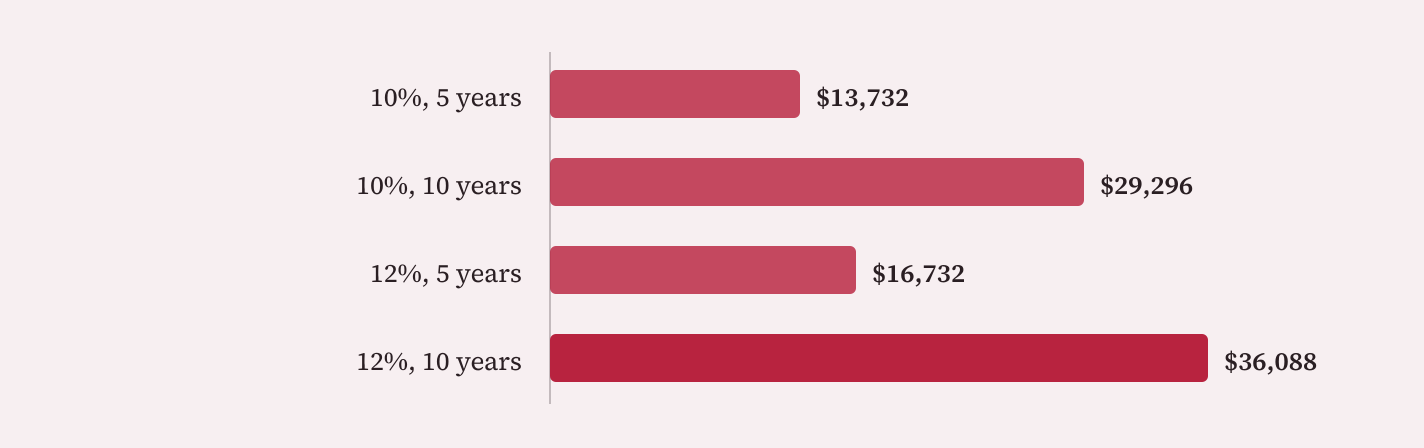
- 10% APR, 5 years (60 payments): about $1,062 a month, $63,732 total repaid, $13,732 in interest.
- 10% APR, 10 years (120 payments): about $661 a month, $79,296 total repaid, $29,296 in interest.
- 12% APR, 5 years (60 payments): about $1,112 a month, $66,732 total repaid, $16,732 in interest.
- 12% APR, 10 years (120 payments): about $717 a month, $86,088 total repaid, $36,088 in interest.
Two patterns stand out. Moving from 10% to 12% adds $3,000 of interest over five years and about $6,800 over ten. Stretching the term from five years to ten cuts the monthly payment by about $400 at 10%, but it adds about $15,600 in total interest.
Reading the output: payment, total interest, and total repaid #
Monthly payment. This is the number to test against your cash flow. The test is your weakest month, not your average month. If the payment would strain the business in a slow season, the loan is too large or the term is too short for your current revenue.
Total interest. This is the cost of borrowing, in dollars. It is the number that makes two offers with similar payments look very different.
Total repaid. This is principal plus interest. Set it against the cash you actually receive to see the full cost of the funds.
Lenders usually ask whether operating cash flow covers the payment, with some margin to spare. To run that check on your own numbers, use a debt service coverage ratio calculator alongside the payment estimate.
Comparing SBA cost with a bank term loan, line of credit, and merchant cash advance #
Cost is only meaningful when the options are priced the same way. The table below puts each option on an annual-rate basis. Where a provider quotes a factor rate, the APR equivalent is shown beside it. The figures are for example only and assume a $50,000 need over eight months, except where noted.
| Option | Typical cost | Speed | What it needs |
|---|---|---|---|
| The SBA 7(a) loan | Lender's rate within SBA limits. For example, 10–12% on $50,000 over 5–10 years costs $13,732 to $36,088 in interest | Usually slower; weeks to months, because of the SBA guaranty process | Eligibility under SBA size standards, a business plan, personal guarantees from owners of 20% or more |
| Bank term loan | Rate and fees set by the bank. For example, about 12.5% APR on $50,000 over 8 months, roughly $2,400 in interest | Often weeks | Financial statements, tax returns, credit history, and sometimes collateral |
| Credit lines for businesses | Interest only on the drawn balance. For example, about 18.5% APR on an average $25,000 drawn over 8 months, roughly $3,100 | Days to weeks once approved | Financials, time in business, credit history, and an annual review |
| Merchant cash advance | Factor rate: 1.28 on $50,000 is a $14,000 cost. 1.28 over 8 months ≈ 70% APR | Often within days | Recent card or deposit sales; repaid through a daily or weekly holdback |
| Revenue-based financing | A fixed total repaid, usually tied to future revenue. Ask for the total and convert it to an APR | Often days | Steady revenue history and recent bank statements |
Read the merchant cash advance line closely. A 1.28 factor on an eight-month term is far more expensive than the bank rates above, even though the funds may arrive in days. For how that conversion works, see the next section.
The SBA loan usually costs less per dollar than a merchant cash advance or revenue-based financing. It also takes longer and asks for more paperwork. The trade-off is time against cost.
The Federal Reserve's Small Business Credit Survey follows which kinds of lenders small companies approach and how those requests are resolved. It is useful context before you choose a type. If you are weighing a receivables-based option, accounts receivable financing vs factoring lays out those costs side by side.
What does an SBA loan calculator actually calculate? #
It calculates the level monthly payment on a fully repaying loan, the total interest over the term, and the total you will repay. It assumes equal payments, no missed payments, and no change in the rate. The output is a planning estimate, not a loan offer. Use it to test a scenario before you ask a lender for a formal quote.
How do I convert a factor rate into an APR so I can compare it? #
A factor rate is a multiplier on the amount funded, not an annual rate. To convert it, find the monthly rate that makes the scheduled payments equal the amount funded, then multiply by 12. For example, a 1.28 factor on $50,000 is $64,000 repaid. Over eight monthly payments of $8,000, the monthly rate is about 5.85%, or roughly 70% a year (1.28 factor over 8 months ≈ 70% APR). Daily or weekly remittances raise the effective rate further, so ask the provider for its annualized figure.
Does the calculator include origination fees and closing costs? #
Most basic calculators do not. They compute payments on the amount you enter, so any upfront fee, closing cost or packaging charge makes the real cost higher than the output. The SBA 7(a) loans carry a federal guaranty fee that the borrower typically pays. Lenders may add their own fees. Add these costs to your figures, or compare the lender's total-cost disclosure against your calculator result.
Is a longer SBA loan term always cheaper? #
No. A longer term lowers the monthly payment, which helps cash flow, but you pay interest for more months. At 10% on $50,000, moving from five years to ten cuts the payment from about $1,062 to about $661 a month. Total interest rises from $13,732 to $29,296. A longer term is cheaper per month, not overall. Choose the shortest term whose payment your weakest month can carry.
Should I use the calculator result to decide how much to borrow? #
Use it to test a number, not to pick one. Start with the specific cost you need to fund, then check whether the payment fits your cash flow in a slow month. Borrowing more than the use requires adds interest on money that sits idle. Keep a margin, and remember that the calculator leaves out fees.
Where an SBA loan earns its place, and where it does not #
An SBA loan fits when you can wait weeks or months for funds, the money will finance a longer-lived need such as equipment, real estate, or working capital with a clear repayment path, and you meet the eligibility rules. The longer term and lower cost per dollar are the reasons to choose it.
It does not fit when you need money in days, when you cannot meet eligibility, or when your revenue cannot carry the payment in a weak month. In those cases a line of credit may suit a variable need better. If a bank will lend without the SBA guaranty at a comparable rate, a conventional loan may be simpler. A merchant cash advance can serve a short, urgent need with strong card sales, provided you have priced it as an APR first.
Next step: run your own numbers in the calculator, and if the payment fits, start your request.
Sources #
This explainer offers general information and is not advice tailored to your situation. Only the terms written into an agreement you sign apply to you. How this site is paid.