Asking how can you reduce your total loan cost comes down to four levers: a lower annual rate, fewer upfront fees, the shortest term you can comfortably carry, and no prepayment penalty that locks you into an expensive balance. Compare every offer on an APR basis before you sign, because a lower monthly payment often means you pay more interest over the life of the loan.
What Your Total Loan Cost Actually Includes #
Your total loan cost is everything you repay above the amount you borrowed. That includes interest, fees charged at closing or during the loan, and any penalties. The monthly payment hides this number, because a payment is only one slice of the whole.
For example, a $50,000 loan repaid over 36 months at an assumed 10% APR carries a payment of about $1,613 a month. You would repay about $58,075 in total, so the total cost is about $8,075. That second figure is the one to compare between offers.
Fees to look for include origination or underwriting charges, document preparation, broker commissions, SBA guaranty fees on SBA loans, late-payment charges, and prepayment penalties. Ask for every one of them in writing. You can run your own payment and total figures with the commercial loan calculator before you talk to a lender.
Compare Rate, APR and Factor Rate on the Same Basis #
An interest rate is the price of borrowing the principal, before fees. The APR, or annual percentage rate, folds most of the upfront costs into one annual figure, so two offers can be compared side by side.
A factor rate works differently. It is a multiplier applied to the amount borrowed. A 1.25 factor on $50,000 means you repay $62,500, which is a $12,500 cost. The factor does not change with time, so the annual cost depends on how fast you repay. Spread across 8 months, a 1.25 factor comes to an annual rate of about 65–75% APR. Repaid more slowly, the annual equivalent falls; repaid quickly, it climbs.
The table below shows how the six common options compare in general terms. These are typical features, not quotes. Your offer sets the actual cost.
| Option | Typical cost | Speed | What it needs |
|---|---|---|---|
| Bank term loan | Interest rate, quoted as APR; often the lowest per dollar here | Usually weeks | Financial statements, tax returns, credit history, time in business |
| The SBA 7(a) loan | Rate capped by SBA rules, plus guaranty and closing fees | Often weeks to months | Eligibility, business plan, personal guarantee, collateral where available |
| Credit lines for businesses | Interest on the amount drawn; fees vary | Weeks to approve, then draw as needed | Revenue history, credit, an approved limit |
| Equipment financing | Interest rate, often fixed; ask for the APR | Days to weeks | A quote for the equipment, which secures the loan |
| Merchant cash advance | Factor rate: 1.25 over 8 months ≈ 65–75% APR | Often days | Recent card sales or bank deposits; a holdback of future receipts |
| Revenue-based financing | Fee on top of principal; ask for the APR | Often days to a few weeks | Monthly revenue records and bank account access |
California requires a provider to give a signed commercial financing disclosure before an offer is final. It must show total dollar cost, term, payment amount and an annualized rate. The Federal Reserve's Small Business Credit Survey also tracks how small firms use each lender type, which helps set expectations about cost and approval.
How Can You Reduce Your Total Loan Cost by Lowering the Rate? #
Rate follows risk. Lenders price on credit history, time in business, revenue consistency, collateral and any personal guarantee. Strengthening these before you apply usually moves the rate more than negotiating after an offer arrives.
Lender type matters too. Banks and SBA-participating lenders usually offer the lowest rates among these options, but they move more slowly and ask for more paperwork. Alternative lenders approve faster and price that speed into the cost.
Pledging collateral, such as equipment or real estate, can lower the rate because the lender's loss is smaller if the loan defaults. SBA's free Lender Match tool connects you with participating lenders, and a Small Business Development Center can help you prepare a financing request at no charge.
Trim Fees, Closing Costs and Hidden Charges #
Fees are often the fastest cost to cut. Ask for a complete fee schedule and sort it into fixed charges and percentages. Origination charges, packaging fees and broker commissions are sometimes negotiable, so ask before you accept.
Watch for costs outside the headline rate: a fee deducted at funding, a daily or weekly charge, a payoff amount higher than the balance, or a default clause that adds penalties. Read the default section closely. Confession-of-judgment clauses, which let a creditor obtain a judgment without a hearing, are one example of terms that some states restrict.
Also check the amount you actually receive. If the lender holds back money at funding or deducts fees before disbursement, the cash in your account may be less than the amount you will repay.
Pick the Term That Keeps Interest Low #
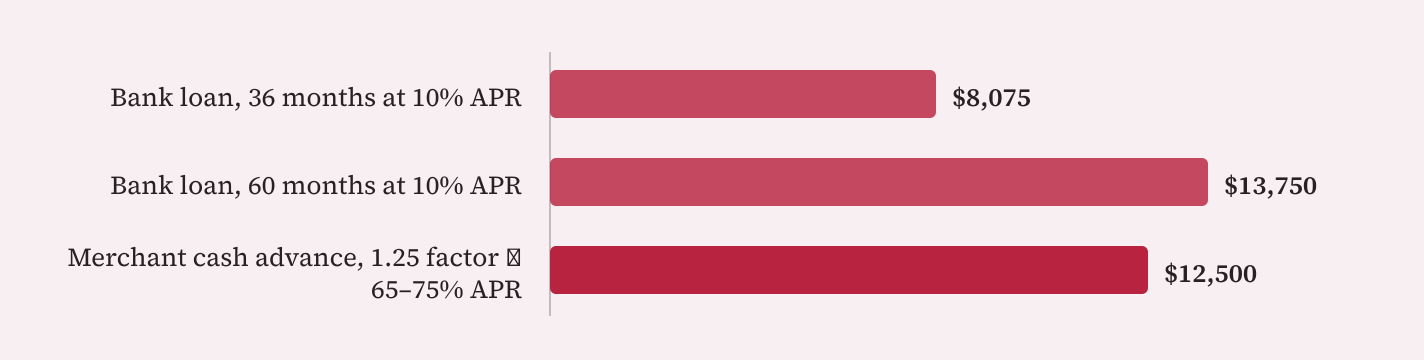
A shorter term means less interest. A longer term lowers the payment and raises the total. Using the same $50,000 at an assumed 10% APR, a 36-month term costs about $8,075 in interest. A 60-month term lowers the payment to about $1,063 a month, but its interest is $13,750, about $5,675 more.
A shorter term is only cheaper if you can carry the payment through slow months. A payment you cannot make leads to default, and default costs far more than the interest you saved. The sba loan calculator can show how term changes payment and total cost on an SBA loan.
Compare that with a merchant cash advance at a 1.25 factor, which repays $12,500 above principal over 8 months (roughly 65–75% APR). The dollar cost looks close to the 36-month term, but the annualized cost is far higher. The chart below sets the three side by side.
When a Bank Term Loan or SBA Loan Is the Better Choice #
A bank term loan or The SBA 7(a) loan is usually the better choice when you have time to wait, a steady financial record, and need a longer term and a lower rate. SBA describes 7(a) uses, maximum amounts, terms and eligibility rules, and the lender's role in each. Review the sba 7a loan requirements before you apply.
For major fixed assets such as real estate or heavy equipment, SBA's 504 program is designed for that purpose. A bank line of credit suits working capital you draw only when needed, and its cost depends on how much you use.
These products are not the right fit when a deadline is days away. Bank and SBA approvals can take weeks, and a late loan can cost you a contract that a faster option would have saved.
Can I Reduce My Total Loan Cost If I Already Have a Loan? #
Yes, in some cases. Prepaying, refinancing or renegotiating a fee can lower what you pay after closing. The details decide whether it helps, so use the questions below to check your own agreement.
What is the difference between an interest rate and APR? #
An interest rate is the annual cost of borrowing the principal. The APR, or annual percentage rate, includes certain fees and spreads them across the year, so it shows a fuller annual cost. Two loans with the same interest rate can have different APRs if one carries heavier upfront fees. When comparing offers, use the APR, and confirm which fees it includes, since lenders calculate it differently.
Does a shorter loan term always cost less in total? #
Usually, because interest accrues over fewer months. But the rate and fees also shape the total. A shorter term means a higher payment, which can strain cash flow. If a missed payment leads to default, the total cost rises far beyond the interest you saved. The shortest term is cheapest only if you can carry it through a slow quarter.
How do I compare a factor rate with an APR? #
First, convert the factor rate into dollars. A 1.25 factor on $50,000 is $62,500 repaid, or $12,500 above principal. Then judge that cost against how long you will hold the money. Spread over 8 months, that same 1.25 factor works out to an annualized rate of roughly 65–75% APR, which is an equivalent figure rather than a stated rate. Compare it with the APR on a bank or SBA offer, and ask the provider for the annualized rate in writing before you accept.
Are prepayment penalties common on business loans? #
They appear in many agreements, but not all, and terms vary by product and lender. Some bank and SBA loans carry a fee for paying off early, while some alternative advances offer a reduced payoff. Others allow no discount for early payoff. Read the prepayment clause before you sign, and ask what the payoff amount would be at three, six and twelve months.
Can refinancing a business loan lower what I pay overall? #
It can, if the new loan has a lower APR, lower fees, and a term that does not add more interest than it saves. Moving a short, expensive advance into a longer, cheaper loan can lower your payment and total cost, but a longer term also adds interest. Compare the dollars remaining on your current loan, including any prepayment charge, with the total of the new loan, and subtract the new loan's fees.
Where Lowering Total Cost Fits Your Situation, and Where It Doesn't #
Lowering total cost is the right goal when you hold a near-final offer, have time to compare, and can carry the repayment through a slow quarter. Through our network of funding partners, we can show total dollar cost and APR side by side so you can compare them directly.
It is not the only goal. When a deadline is days away and a delayed approval would cost you a contract, a faster option can be worth its higher price, provided you know the total and have a plan to repay it. A cheap term you cannot carry is the most expensive loan you can take.
When you are ready to compare real offers, start your request.
Sources #
This explainer offers general information and is not advice tailored to your situation. Only the terms written into an agreement you sign apply to you. How this site is paid.